Support our educational content for free when you purchase through links on our site. Learn more
How to Spot Eco-Friendly Handbag Brands 🌿

To answer “How can I identify eco-friendly handbag brands?”, check the full material composition, supply chain, worker standards, durability, certifications, and repair options instead of trusting a leafy logo or the word “vegan.” The best brands make specific claims you can verify, from recycled-content percentages to factory locations and take-back programs.
We’ve inspected plenty of handbags that looked wonderfully virtuous online, only to discover a mystery coating, a synthetic lining, and no information about who made them. We’ve also found genuinely thoughtful brands using recycled leather, organic fibres, repurposed materials, and plant-based alternatives without pretending that one material solves every environmental problem.
A useful rule is this: the most eco-friendly handbag is usually the one you will carry often, maintain carefully, repair when needed, and keep for years. That makes durability and versatility just as important as the fabric on the product page.
Key Takeaways
- Read the complete materials list: Look beyond “vegan,” “natural,” or “recycled” and check the outer, lining, backing, coatings, and hardware.
- Verify sustainability certifications: GRS, GOTS, OEKO-TEX, Leather Working Group, Fair Trade, and B Corp credentials each cover different criteria.
- Investigate the supply chain: Trust brands that identify factories, workshops, artisans, tanneries, worker protections, and environmental goals.
- Treat vegan as a material description, not a sustainability guarantee: Many vegan handbags contain polyurethane, PVC, or other synthetic coatings.
- Prioritize long-term use: Strong stitching, quality hardware, repair services, warranties, and timeless designs can reduce replacement purchases.
- Consider secondhand first: A well-made pre-owned handbag can extend an existing product’s life and avoid new production.
- Spot greenwashing: Be cautious of vague claims such as “conscious,” “eco,” “planet-friendly,” and “made with recycled materials” without percentages or evidence.
- Compare the whole lifecycle: Materials, manufacturing, packaging, shipping, care, repair, resale, and disposal all matter.
Table of Contents
- ⚡️ Quick Tips and Facts: How to Spot an Eco-Friendly Handbag Brand
- ✅ The fastest sustainability checks to make
- ❌ Greenwashing red flags to avoid
- 🌿 Materials, certifications, and ethics at a glance
- 🌍 What Makes a Handbag Brand Truly Sustainable?
- The difference between eco-friendly, ethical, vegan, and sustainable bags
- Why lifecycle thinking matters more than a trendy label
- How durability, repair, resale, and end-of-life plans fit together
- 🧵 A Brief History of Sustainable Handbags and Conscious Fashion
- From recycled materials to circular fashion
- How vegan leather changed the handbag industry
- Why transparency has become a consumer priority
- 🔍 How Can Identify Eco-Friendly Handbag Brands?
- 1. Read the brand’s materials policy
- 2. Investigate manufacturing and supply-chain transparency
- 3. Check labor standards and worker protections
- 4. Look for credible sustainability certifications
- 5. Examine packaging, shipping, and carbon claims
- 6. Assess product quality and expected lifespan
- 7. Search for repairs, take-back, and resale programs
- 8. Compare sustainability claims with independent evidence
- 🌱 Sustainable Handbag Materials: Which Fabrics Are Actually Better?
- Recycled leather and upcycled leather
- Plant-based leather alternatives: apple, cactus, grape, mushroom, and pineapple
- Recycled polyester, nylon, and ocean-bound plastic
- Organic cotton, hemp, linen, and recycled canvas
- Cork, raffia, jute, and other natural fibers
- Conventional leather versus vegan leather: the nuanced answer
- Materials we approach with caution
- 🏷️ Certifications and Standards That Help Verify Sustainable Bags
- Global Recycled Standard and Recycled Claim Standard
- GOTS, Organic Content Standard, and organic fibers
- OEKO-TEX, bluesign, and safer chemical management
- Leather Working Group and responsible leather sourcing
- Fair Trade, SA800, B Corp, and social responsibility
- Why certification alone does not tell the whole story
- 🏆 25+ Eco-Friendly Handbag Brands Worth Investigating
- 1. HYER GOODS: Recycled leather with a circular mindset
- 2. Cuyana: Fewer, better bags and long-term design
- 3. Allégorie: Plant-based materials with polished style
- 4. Sézane: Responsible sourcing with Parisian appeal
- 5. Quince: Accessible materials and supply-chain information
- 6. Pixie Mood: Vegan handbags made with lower-impact materials
- 7. Bagu: Reusable designs and recycled nylon staples
- 8. ABLE: Ethical production and artisan-made accessories
- 9. Stella McCartney: Luxury without conventional animal leather
- 10. VIVAIA: Recycled textiles and responsible footwear-to-bag innovation
- 11. Matt & Nat: Longstanding vegan handbag design
- 12. FREITAG: One-of-a-kind bags made from repurposed truck tarps
- 13. Freitag F-ABRIC: Compostable textile experiments
- 14. Angela Roi: Vegan bags with a charitable mission
- 15. MERSI: Ethical craftsmanship and responsible materials
- 16. Nisolo: Leather goods with worker-focused transparency
- 17. Parker Clay: Artisan production and social impact
- 18. Oroton: Responsible luxury and recycled-material initiatives
- 19. Rothy’s: Recycled plastic fibers and circularity efforts
- 20. Lo & Sons: Travel bags designed for repeat wear
- 21. Canopy Verde: Handcrafted plant-based and recycled designs
- 22. Svala: Luxury vegan bags with innovative textiles
- 23. Sans Beast: Animal-free handbags with contemporary styling
- 24. Melina Bucher: Premium vegan bags and material innovation
- 25. Mashu: Sculptural vegan handbags with responsible sourcing
- 26. Deux Mains: Fair-trade leather and artisan empowerment
- 27. Nisolo: Timeless leather bags with ethical production goals
- 28. Elvis & Kresse: Luxury accessories from rescued materials
- 👜 Best Sustainable Handbag Brands by Style and Use
- Eco-friendly work totes for laptops and commuting
- Sustainable crossbody bags for everyday errands
- Ethical handbags for travel and organized packing
- Vegan evening bags for weddings and special occasions
- Minimalist sustainable handbags for capsule wardrobes
- Eco-friendly backpacks and convertible bags
- Sustainable handbags for students and busy parents
- 💸 How to Compare Sustainable Handbags by Budget, Quality, and Value
- Affordable eco-friendly bags that do not feel disposable
- Mid-range ethical handbags worth the investment
- Premium and luxury sustainable handbags
- Cost per wear: the handbag calculation we actually use
- 🧪 How to Investigate a Brand’s Sustainability Claims
- Questions to ask before buying an eco-conscious handbag
- How to read an impact report without falling asleep
- How to verify “carbon neutral” and “plastic-free” language
- What a transparent materials page should include
- 🛍️ How to Shop for an Eco-Friendly Handbag Secondhand
- The most sustainable handbag may already exist
- Best resale platforms for designer and ethical bags
- How to inspect leather, hardware, lining, and stitching
- Authenticity checks and counterfeit warning signs
- 🧼 How to Make Your Sustainable Handbag Last Longer
- Cleaning vegan leather, leather, canvas, and recycled nylon
- Storage tips that prevent cracks, stains, and warped shapes
- Repairing straps, zippers, corners, and lining
- When to resell, donate, upcycle, or recycle a handbag
- ⚠️ Common Greenwashing Tricks in the Handbag Industry
- “Vegan” does not automatically mean environmentally friendly
- Why “made with recycled materials” can be vague
- The trouble with tiny capsule collections and big claims
- How vague words hide weak sustainability practices
- 📊 Sustainable Handbag Comparison Checklist
- Materials and certifications checklist
- Labor and manufacturing checklist
- Durability and circularity checklist
- A simple eco-friendly handbag scoring system
- 🌎 The Environmental and Social Impact of Handbag Production
- Water use, chemicals, waste, and emissions
- Animal welfare and leather supply chains
- Worker rights, wages, and safe working conditions
- Packaging, delivery, returns, and their hidden footprint
- 🧭 Building a More Sustainable Handbag Collection
- The one-bag, three-bag, and capsule wardrobe approaches
- Choosing versatile colors, silhouettes, and hardware
- How to resist microtrends and impulse purchases
- A practical handbag buying decision tree
- ❓ Questions to Ask Before Buying an Eco-Friendly Handbag
- Is the bag made from recycled or renewable materials?
- Where was the handbag manufactured?
- Can the brand prove its ethical and environmental claims?
- Will the brand repair, take back, or recycle it?
- 🔗 Related Reading for Conscious Fashion Shoppers
- Conclusion
- Recommended Links
- FAQ
- What is the most eco-friendly material for a handbag?
- Are vegan handbags better for the environment?
- How can I tell if a handbag brand is ethical?
- What certifications should sustainable handbag brands have?
- Are expensive handbags more sustainable?
- Is buying a secondhand handbag the most sustainable option?
- How long should a sustainable handbag last?
- How should I dispose of an old handbag responsibly?
- Reference Links
Quick Tips and Facts: How to Spot an Eco-Friendly Handbag Brand
The first line of investigation is our guide to sustainable handbag brands, but the short version is wonderfully practical: look past “vegan,” “conscious,” and “eco” until you can verify the material, factory, workers, and aftercare. A leafy logo is not a sustainability report. 🌿
| Check first | What credible evidence looks like | Warning sign |
|---|---|---|
| Materials | Exact fibre composition, recycled percentage, named certification | “Eco material” with no detail |
| Manufacturing | Factory location, supplier information, production standards | “Made responsibly” with no explanation |
| Labor | Audits, living-wage commitments, artisan partnerships, worker policies | Ethical language without worker evidence |
| Longevity | Strong construction, repair service, spare parts, warranty | Trend-led design and disposable hardware |
| End of life | Take-back, resale, repair, recycling instructions | No care or disposal guidance |
| Packaging | Recycled or reusable packaging with specific claims | Excessive plastic and vague “green” labels |
✅ The fastest sustainability checks to make
Use this five-minute brand audit before you add anything to your cart:
-
Open the product materials tab.
Look for terms such as recycled nylon, GRS-certified polyester, organic cotton, cork, vegetable-tanned leather, or a clearly named plant-based alternative. The Global Recycled Standard verifies recycled content and chain of custody, although certification does not make every product impact-free. -
Search the brand’s manufacturing page.
A trustworthy company usually identifies countries, workshops, factories, or artisan groups. Parker Clay puts the principle neatly: shoppers should seek “true sustainability and transparency throughout production and the supply chain.” That is more useful than a slogan because it tells you what to investigate. -
Check the numbers.
“Made with recycled materials” could mean 5% or 95%. Prefer specific statements such as “100% recycled polyester shell” over impressive-sounding fog. -
Look for durability signals.
Examine stitching, edge paint, lining, strap attachment, zipper quality, and hardware. Sustainability begins with not replacing the bag next season. The European Environment Agency has repeatedly linked longer product use with lower environmental pressure. -
Find the repair or return policy.
A repair service, replacement strap, resale scheme, or take-back program suggests the brand has considered the handbag’s second act. -
Cross-check certifications.
Check GOTS, OEKO-TEX, Leather Working Group, or B Corp. Certifications vary widely, so read what each one actually covers.
❌ Greenwashing red flags to avoid
Parker Clay warns that phrases such as “eco-friendly materials,” “recycled materials,” “vegetable-tanned leather,” “cruelty-free,” and “ethical handbags” can be used without enough supporting detail. We agree. These phrases are not automatically false; they are simply unfinished answers.
Watch for:
- A single “hero material” masking an opaque product. A recycled outer shell does not tell you about the lining, glue, metal, dye, packaging, or factory.
- “Vegan” used as a synonym for sustainable. Many vegan leathers are polyurethane- or PVC-based plastics. The European Commission’s textile strategy supports examining durability, circularity, and chemical impacts rather than relying one label.
- Carbon-neutral language with no methodology. Ask whether reductions came first or whether offsets carry the entire claim.
- Tree planting as the main sustainability argument. A tree can be positive; it does not erase poor labor conditions or a short-lived bag.
- No percentages. “Contains recycled content” is weaker than a fibre breakdown.
- Only polished lifestyle photography. If a brand shows beaches, leaves, and linen but not factories, suppliers, or repair information, our stylist radar starts to beep. 🚨
🌿 Materials, certifications, and ethics at a glance
| Material or claim | Potential benefit | Limitation | What to verify |
|---|---|---|---|
| Recycled nylon or polyester | Reduces reliance on virgin fossil-based feedstock | Still synthetic and may shed fibres | Recycled percentage and GRS certification |
| Organic cotton | Avoids many conventional agricultural inputs | Can still require substantial water and land | GOTS certification and recycled content |
| Cork | Renewable, lightweight, and naturally water-resistant | Quality varies; thin coatings may affect durability | Cork source and backing material |
| Raffia, jute, or rattan | Renewable natural fibres and artisan-friendly | Can be sensitive to moisture and abrasion | Fibre origin, dyes, and construction |
| Piñatex or fruit-waste materials | Uses agricultural by-products | Often includes synthetic binders or coatings | Full composition and end-of-life route |
| Recycled leather | Diverts leather waste from disposal | May use binders and offer limited recyclability | Recycled percentage and coating |
| Conventional leather | Can be extremely durable and repairable | Livestock, tanning, and traceability impacts | Tannery standards and LWG status |
| Vegan leather | Avoids animal-derived materials | Frequently plastic-based | Polymer type, recycled content, and longevity |
🌍 What Makes a Handbag Brand Truly Sustainable?
There is no single perfect handbag material. The strongest brands combine responsible materials with durable design, fair production, transparency, and a plan for repair or reuse. A beautiful cactus-leather bag made in an opaque supply chain is not automatically a better choice than a long-lasting secondhand leather bag. That slightly inconvenient answer is also the honest one.
The difference between eco-friendly, ethical, vegan, and sustainable bags
These terms overlap, but they are not interchangeable:
- Eco-friendly: Usually refers to reduced environmental impact, although it is often too vague without evidence.
- Ethical: Commonly refers to workers, wages, safety, animal welfare, and community impact.
- Vegan: Means the product excludes animal-derived materials. It says nothing by itself about emissions, plastics, labor, or durability.
- Sustainable: A broad term covering environmental and social impacts across a product’s lifecycle.
A handbag can be:
- ✅ Vegan and lower-impact: for example, a bag using recycled polyester with verified content and strong repair options.
- ✅ Leather and responsibly managed: made with traceable leather, robust construction, and a long usable life.
- ❌ Vegan but not especially sustainable: made from virgin PVC, difficult to repair, and designed for short-term trend appeal.
- ❌ Natural but not automatically ethical: a plant fibre can still involve poor labor conditions or wasteful production.
Why lifecycle thinking matters more than a trendy label
We assess handbags across five stages:
- Raw materials: Where did the fibre, leather, metal, or coating originate?
- Processing: How much water, energy, and chemistry were involved?
- Manufacturing: Who made the bag, and under what conditions?
- Use: How long will it last, and can it be repaired?
- End of life: Can it be resold, refurbished, recycled, or safely discarded?
The United Nations Environment Programme emphasizes circularity across the textile value chain. For handbags, that means buying less frequently, choosing longevity, and keeping products in use can matter as much as selecting an attractive material.
How durability, repair, resale, and end-of-life plans fit together
Our stylists use the “three-year test”: Can you realistically imagine carrying this handbag through three years of outfits, commutes, weather, and ordinary mishaps?
Look for:
- Reinforced strap anchors
- Even, dense stitching
- Replaceable or repairable hardware
- A lining that can be cleaned
- Protective feet or durable base construction
- Neutral or genuinely loved color
- A brand repair, restoration, or warranty service
The most convincing sustainability claim may be unglamorous: “We will repair your bag.” Marici, highlighted by Harper’s Bazaar, offers a lifetime guarantee and encourages restoration or recycling rather than disposal. That practical promise is stronger than a green icon floating beside a product photo.
🧵 A Brief History of Sustainable Handbags and Conscious Fashion

From recycled materials to circular fashion
Sustainable handbags once sat in a narrow corner of the market: hemp totes, undyed canvas, and a few earnest-looking drawstring bags. The category has broadened. Brands now experiment with:
- Recycled ocean-bound plastic
- Recycled nylon and polyester
- Fruit-waste composites
- Mushroom-based materials
- Cork and raffia
- Upcycled leather and production offcuts
- Deadstock textiles
- Repurposed industrial materials
FREITAG helped make repurposed truck tarpaulins desirable rather than merely practical, while Elvis & Kresse turns rescued materials into luxury accessories. The lesson is stylishly simple: waste can become a design brief.
How vegan leather changed the handbag industry
“Vegan leather” initially made shoppers think of one thing: plastic leather-look material. That category remains significant, but newer products use mixed approaches such as:
- Recycled polyurethane
- Plant-based coatings
- Pineapple-leaf fibre
- Apple-waste composites
- Cactus-based materials
- Mycelium experiments
However, a plant input does not guarantee a fully biodegradable handbag. Many plant-based alternatives contain polyurethane or polyester backing for strength and water resistance. Always read the full composition, not just the front-of-label material name.
Why transparency has become a consumer priority
Consumers have become more skeptical of broad claims because fashion supply chains are complicated. The Federal Trade Commission Green Guides advise marketers to qualify environmental claims so shoppers are not misled.
That is why we favor a brand that says:
“The outer is 70% recycled polyester, the lining is conventional polyester, production occurs in Portugal, and repairs are available.”
over one that says:
“A conscious bag for a better future.”
The first statement is imperfect but testable. The second is lovely copy and very little else.
🔍 How Can Identify Eco-Friendly Handbag Brands?
1. Read the brand’s materials policy
Start with the product page, then move to the materials or responsibility section. Record:
- Outer material
- Lining
- Backing and coatings
- Thread
- Hardware
- Adhesives, if disclosed
- Recycled organic percentage
- Certification names
- Country of origin
For example, Stella McCartney’s official responsibility information discusses alternative materials and animal-free design, but shoppers should still inspect the composition of each individual bag.
2. Investigate manufacturing and supply-chain transparency
Search for:
- Named factories or workshops
- Country and region of manufacture
- Tannery information
- Supplier audits
- Artisan cooperatives
- Worker grievance systems
- Environmental management standards
Harper’s Bazaar highlights Manu Atelier, which produces in its own workshop and says this gives the brand greater control over quality and sustainability. It also discusses 071 Tbilisi, which keeps its business in Georgia to maintain control over materials, suppliers, and production.
That does not mean local production is automatically superior. It means greater visibility can make claims easier to verify.
3. Check labor standards and worker protections
Ethical handbags should answer more than “Who made it?” Ask:
- Are workers paid legally, fairly, or at a living wage?
- Are working hours and safety standards monitored?
- Are subcontractors disclosed?
- Does the brand support artisans beyond one seasonal collection?
- Can workers raise complaints safely?
Certifications such as SA800, Fair Trade, and B Corp may provide useful signals, but their scope differs. An artisan partnership can also be meaningful when the brand explains the relationship, payment model, and continuity.
4. Look for credible sustainability certifications
Use certifications as evidence, not a shortcut.
| Certification or standard | What it may help verify | What it does not automatically prove |
|---|---|---|
| GRS | Recycled content and chain of custody | Perfect environmental performance |
| GOTS | Organic fibres plus processing criteria | Every component of a finished handbag |
| OEKO-TEX | Tested substances and chemical safety | Fair wages or low carbon emissions |
| LWG | Leather-tannery environmental practices | The entire brand supply chain |
| Fair Trade | Specific social and trading criteria | All materials in the product |
| B Corp | Company-level social and environmental governance | That every product is sustainable |
| bluesign | Chemical and resource-management systems | Full product circularity |
5. Examine packaging, shipping, and carbon claims
A sustainable bag arriving in a mountain of plastic has missed an easy opportunity. We check whether packaging is:
- Recycled
- Recyclable in realistic local systems
- Reusable
- Right-sized
- Free from unnecessary tissue, foam, and laminated inserts
For carbon claims, look for a published methodology and reduction targets. The Science Based Targets initiative offers a framework for credible emissions reduction goals. Offsetting should not substitute for reducing manufacturing and transport emissions.
6. Assess product quality and expected lifespan
A handbag earns sustainability points by surviving real life. Test the design mentally:
- Can the strap handle a full day’s load?
- Are stress points reinforced?
- Does the closure protect the contents?
- Is the lining sewn rather than loosely glued?
- Will pale untreated fabric show every coffee incident?
- Can you find a repairer if the zipper fails?
Design versatility matters too. A structured black tote may serve work, travel, and weekends, while a novelty microbag may be delightful but less frequently worn. Our rule is not “buy boring.” It is buy the bag you will actually carry.
7. Search for repairs, take-back, and resale programs
Look for specific language:
- “We repair broken straps.”
- “Replacement hardware is available.”
- “Return your used bag for refurbishment.”
- “We resell certified pre-owned pieces.”
- “We accept bags for material recovery.”
Avoid confusing a donation campaign with a full circular program. Donation can extend use, but it does not guarantee the bag will find a suitable owner.
8. Compare sustainability claims with independent evidence
Search the brand name alongside:
- “impact report”
- “factory list”
- “certification”
- “repair”
- “materials composition”
- “labor practices”
- “lawsuit” or “regulatory action,” when relevant
Reliable sources include the FTC Green Guides, Textile Exchange, Ellen MacArthur Foundation, and government consumer-protection agencies.
🌱 Sustainable Handbag Materials: Which Fabrics Are Actually Better?
Recycled leather and upcycled leather
Upcycled leather uses existing leather offcuts, vintage pieces, or production waste. It can reduce disposal, but “recycled leather” may refer to a bonded composite containing leather fibres plus polyurethane or other binders.
Benefits:
- Diverts waste
- Can create distinctive textures
- Often uses existing material streams
Drawbacks:
- May be harder to repair
- Composition can be unclear
- Not always recyclable at end of life
Ask for the percentage of recycled content and whether the product can be separated or repaired.
Plant-based leather alternatives: apple, cactus, grape, mushroom, and pineapple
Plant-based alternatives are exciting, but their names can sound more biodegradable than the finished product really is. Piñatex, associated with pineapple-leaf fibre, and other fruit- or cactus-based materials may include synthetic coatings or backing.
| Alternative | Appealing feature | Question to ask |
|---|---|---|
| Pineapple leaf fibre | Uses agricultural by-product | What percentage is plant fibre? |
| Apple waste composite | Uses food-industry residue | What are the binder and coating? |
| Cactus-based material | Often marketed as lower-water input | Is the backing plastic-based? |
| Grape waste material | Uses winery by-products | Is the final material recyclable? |
| Mycelium | Grown from fungal networks | Is it commercial-scale and what supports it? |
Our verdict: promising, but judge the complete material specification.
Recycled polyester, nylon, and ocean-bound plastic
Recycled synthetics can reduce virgin fossil-based input and make practical, water-resistant bags. BAGU, for example, is known for reusable bags and recycled-nylon products; review its official materials information product by product.
Potential limitations include:
- Microfibre shedding
- Dependence on synthetic coatings
- Limited end-of-life recycling
- Difficulty separating mixed materials
Look for GRS certification and a clear fibre breakdown.
Organic cotton, hemp, linen, and recycled canvas
Natural fibres can be excellent for totes and casual handbags, especially when woven densely and reinforced at stress points.
- Organic cotton: Check GOTS certification.
- Hemp: Durable and generally requires fewer agricultural inputs than some conventional fibres, but processing and blends still matter.
- Linen: Strong and breathable, though often blended or coated in structured bags.
- Recycled canvas: Useful when the recycled percentage is disclosed.
A canvas tote is not automatically sustainable if it is rarely used. The greenest tote is the one that replaces repeated disposable bags.
Cork, raffia, jute, and other natural fibers
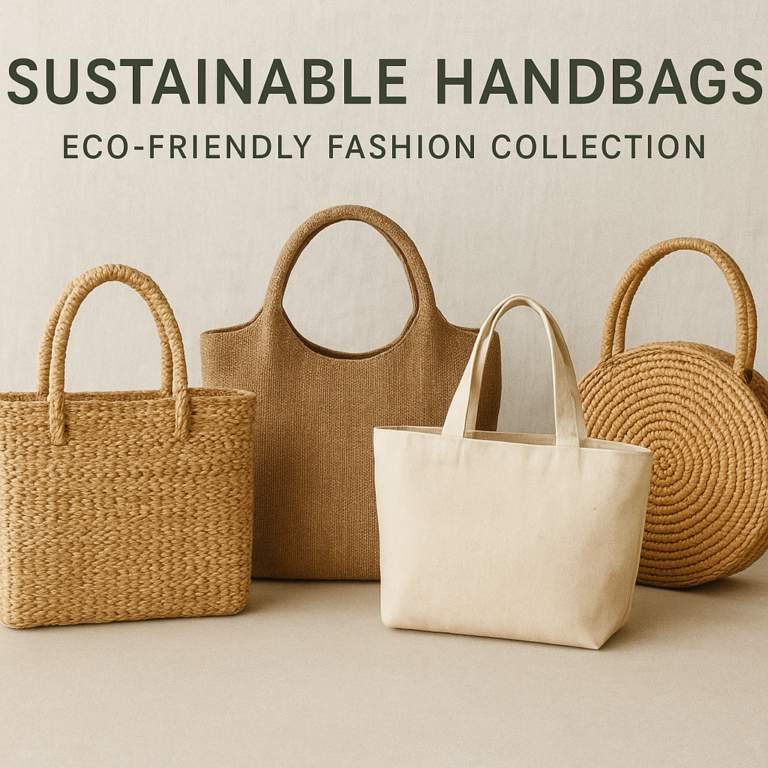
These materials bring texture and summer energy without pretending to be a formal briefcase. In the featured video, Made Trade, Mari Sol, AKS, Nannacay, and KAUnique are presented as examples of colorful, artisan-focused summer bags using materials such as jute, raffia, sea grass, straw, cotton, and vegetable-tanned leather.
Harper’s Bazaar also highlights Wicker Wings, which combines rattan with Italian vegetable-tanned leather, and describes rattan as a fast-growing, replenishable natural material.
Check:
- Moisture resistance
- Dye and finish chemistry
- Harvesting practices
- Artisan payment and continuity
- Whether the handles and base can withstand daily use
Conventional leather versus vegan leather: the nuanced answer
This is where online arguments tend to put on boxing gloves. The better answer depends on source, longevity, chemistry, and use.
| Choice | Strength | Concern |
|---|---|---|
| High-quality, traceable leather | Long lifespan, repairability, patina | Animal agriculture and tanning impacts |
| Recycled leather | Uses existing waste | Binders may reduce recyclability |
| PVC vegan leather | Animal-free and inexpensive | Persistent plastic and weaker durability concerns |
| PU vegan leather | Softer and often more flexible than PVC | Still fossil-derived unless partly recycled |
| Plant-based composite | Renewable or waste-derived input | Often blended with synthetics |
| Secondhand leather | Extends an existing product’s life | Condition and authenticity require checking |
The Leather Working Group can help assess tannery practices, but it does not transform leather into a zero-impact material. Likewise, “vegan” avoids animal materials but does not guarantee a low-impact product.
Materials we approach with caution
Be especially curious about:
- PVC with no recycled content
- Unspecified “eco-leather”
- “Bio-based” materials without a bio-based percentage
- Laminated mixed-material bags
- Faux leather that flakes after limited wear
- Glitter, metallic coatings, and difficult-to-separate embellishments
- Products labeled biodegradable without conditions or testing details
🏷️ Certifications and Standards That Help Verify Sustainable Bags
Global Recycled Standard and Recycled Claim Standard
The Global Recycled Standard covers recycled content and chain of custody, with additional social, environmental, and chemical criteria. The Recycled Claim Standard focuses more narrowly on verifying recycled content.
Stylist tip: certification should appear in product or supply-chain documentation, not only in a vague “sustainable” banner.
GOTS, Organic Content Standard, and organic fibers
GOTS covers organic fibres and processing criteria, while the Organic Content Standard verifies organic material content. For a cotton handbag, GOTS is generally the more comprehensive signal because it addresses processing requirements as well.
OEKO-TEX, bluesign, and safer chemical management
OEKO-TEX tests for harmful substances in certified products. bluesign focuses on chemical and resource management within textile production.
Neither certification alone proves fair wages, recycled content, or a long product lifespan. Think of them as one piece of the evidence puzzle.
Leather Working Group and responsible leather sourcing
LWG assesses participating leather manufacturers for environmental practices, energy, water, waste, and chemical management. Ask whether the specific leather supplier or tannery is covered, rather than assuming an entire brand’s collection is.
Fair Trade, SA800, B Corp, and social responsibility
- Fair Trade can indicate defined trading and social criteria.
- SA800 focuses on social accountability.
- B Corp evaluates a company’s broader governance and impact.
These standards can strengthen a brand’s credibility, but always check scope, date, and certification holder.
Why certification alone does not tell the whole story
A certified material can sit inside:
- A poorly designed bag
- A product with disposable hardware
- Excessive packaging
- A short-lived trend collection
- An opaque labor system outside the certified stage
We trust brands most when certifications sit beside specific material percentages, factory information, repair policies, and impact goals.
🏆 25+ Eco-Friendly Handbag Brands Worth Investigating
This list is not a declaration that every product from every brand is perfect. It is a research shortlist. Read the individual product pages, because collections and materials change.
| Brand | Sustainability angle | Best for | Watch for |
|---|---|---|---|
| HYER GOODS | Recycled and upcycled materials | Modern everyday bags | Product-specific composition |
| Cuyana | Long-wear, fewer-better design | Minimalist wardrobes | Leather sourcing and care |
| Allégorie | Vegan and plant-based alternatives | Polished animal-free style | Full coating composition |
| Sézane | Repair, responsibility, and material initiatives | French-inspired accessories | Varies by collection |
| Quince | Accessible leather and material transparency | Everyday value | Product-level standards |
| Pixie Mood | Vegan and recycled materials | Colorful cruelty-free bags | Synthetic content |
| BAGU | Reusable and recycled nylon styles | Casual utility | Not every item is identical |
| ABLE | Ethical production and worker focus | Structured everyday bags | Material blend |
| Stella McCartney | Animal-free luxury and alternative materials | Designer style | Premium materials remain complex |
| VIVAIA | Recycled textile innovation | Light, contemporary accessories | Confirm handbag composition |
| FREITAG | Repurposed truck tarpaulin | One-of-a-kind utility | Texture and color vary |
| Elvis & Kresse | Rescued industrial materials | Distinctive luxury | Availability can vary |
| Rothy’s | Recycled plastic-based materials | Lightweight casual bags | Synthetic end-of-life issues |
| Parker Clay | Artisan production and supply-chain transparency | Leather handbags | Verify current sourcing |
| Nisolo | Worker-focused leather production | Classic leather | Leather remains resource-intensive |
| Matt & Nat | Longstanding vegan handbag design | Vegan basics | Many materials are synthetic |
| Angela Roi | Vegan materials and charitable partnerships | Refined animal-free bags | Check current material details |
| Svala | Vegan luxury aesthetics | Minimalist statement bags | Composition varies |
| Sans Beast | Animal-free contemporary designs | Fashion-forward vegan bags | Coatings and durability |
| Melina Bucher | Premium vegan innovation | Elevated animal-free style | Availability and material changes |
| Mashu | Recycled materials and Greek craftsmanship | Sculptural vegan bags | Confirm recyclability by model |
| Marici | Plant-based alternatives and repair focus | Luxury vegan bags | Composite construction |
| Nannacay | Artisan-made natural-fibre designs | Woven summer bags | Seasonal care |
| AKS | Ghanaian artisan weaving | Colorful baskets | Moisture and storage |
| Made Trade | Curated ethical marketplace | Research and discovery | Marketplace standards vary |
| Mari Sol | Raffia and Madagascar craftsmanship | Resort-style bags | Delicate natural fibres |
| Chylak | Recycled and lower-impact materials | Fashion-led polish | Model-specific composition |
| BEEN London | Recycled and rescued materials | Contemporary city bags | Small-batch availability |
1. HYER GOODS: Recycled leather with a circular mindset
HYER GOODS is worth investigating for shoppers drawn to recycled leather, upcycling, and clean-lined silhouettes. The brand’s appeal is practical: polished shapes that do not look like a compromise.
Potential strengths:
- Reclaimed or recycled material focus
- Modern, office-friendly design
- Strong visual distinction from typical canvas totes
Questions to ask:
- What percentage of each component is recycled?
- Is the lining recycled?
- What repair or take-back options apply to the specific bag?
2. Cuyana: Fewer, better bags and long-term design
Cuyana centers much of its identity around fewer, better things, an idea that makes sense for handbags because repeated use is the quiet hero of sustainability.
We especially like Cuyana for:
- Timeless silhouettes
- Work totes and organized everyday bags
- A wardrobe approach rather than constant novelty
The drawback is that restrained design does not erase the impact of leather or mixed components. Inspect the material page and care instructions before deciding.
3. Allégorie: Plant-based materials with polished style
Allégorie offers vegan handbags using alternative materials, making it appealing to shoppers who want a refined look without animal leather.
Best for: structured vegan styles and work-to-weekend versatility.
Check carefully: plant-based does not necessarily mean plastic-free. Review the exact composition, coating, and recyclability.
4. Sézane: Responsible sourcing with Parisian appeal
Sézane has built sustainability and responsibility initiatives into its broader brand story, including material and social programs.
We recommend checking:
- Current certification claims
- The exact leather or textile source
- Product care and longevity
- Whether the item is part of a limited responsible-material range
For readers who love French styling, Sézane can be an attractive bridge between trend and timelessness.
5. Quince: Accessible materials and supply-chain information
Quince appeals to shoppers seeking everyday leather goods and transparent product descriptions. Its strongest sustainability argument is often practical value and repeated wear, rather than dramatic eco-language.
Look for:
- Fibre composition
- Tannery or factory information
- Construction details
- Warranty and care support
6. Pixie Mood: Vegan handbags made with lower-impact materials
Pixie Mood is a strong candidate for shoppers seeking animal-free handbags with colorful, accessible styling.
Benefits:
- Wide range of vegan silhouettes
- Useful organization
- Playful color options
Trade-off: many vegan handbags use synthetic polymers. Confirm whether a model includes recycled content and how it should be disposed of.
7. BAGU: Reusable designs and recycled nylon staples
BAGU is best known for practical reusable bags, pouches, and casual carryalls. Its appeal is simple: a bag that gets used repeatedly can displace many disposable alternatives.
We like BAGU for:
- Lightweight construction
- Packability
- Everyday utility
- Playful prints that encourage frequent use
For a structured work bag, look elsewhere. For errands, travel, and grocery duty, BAGU earns its place.
8. ABLE: Ethical production and artisan-made accessories
ABLE emphasizes ethical production and transparency, with handbags that lean classic rather than costume-like.
Investigate:
- Worker and wage reporting
- Factory relationships
- Leather sourcing
- Repair and warranty coverage
ABLE is particularly compelling for shoppers who want their sustainability research to include people, not just materials.
9. Stella McCartney: Luxury without conventional animal leather
Stella McCartney is one of the best-known luxury names associated with animal-free handbags and alternative materials.
Strengths:
- Strong design identity
- Clear animal-free positioning
- Investment-level styling
Considerations:
- Animal-free does not mean impact-free
- Coatings and synthetic components deserve scrutiny
- Luxury packaging and production still matter
It is a persuasive option for shoppers who want recognizable designer styling without conventional leather.
10. VIVAIA: Recycled textiles and responsible footwear-to-bag innovation
VIVAIA is associated primarily with footwear but also offers accessories and bags using recycled textile concepts. Check each product because material claims can differ across categories.
11. Matt & Nat: Longstanding vegan handbag design
Matt & Nat has spent years building a recognizable vegan handbag line. Its clean shapes make it easy to style with capsule wardrobes.
Pros: broad range, animal-free design, functional interiors.
Cons: vegan materials are often synthetic, so lifespan and coating quality matter.
12. FREITAG: One-of-a-kind bags made from repurposed truck tarps
FREITAG turns used truck tarpaulins into durable, distinctive bags. Every piece has a visual history: scratches, faded panels, and all.
Why we love it: high individuality and genuine repurposing.
Potential drawback: the industrial look is not for every office or evening outfit.
13. Elvis & Kresse: Luxury accessories from rescued materials
Elvis & Kresse rescues materials such as decommissioned fire hoses and transforms them into accessories.
It is an excellent example of material rescue paired with design desirability, though shoppers should still assess hardware, lining, and repair options.
14. Parker Clay: Artisan production and social impact
Parker Clay places unusual emphasis on transparency and ethical production. Its central message is particularly useful for shoppers: do not stop at sustainability terminology; investigate how the bag is made.
15. Nisolo: Timeless leather bags with ethical production goals
Nisolo is known for leather footwear and accessories, with a strong emphasis on worker-focused practices.
The honest trade-off: leather can be durable and repairable, but shoppers should still examine tannery sourcing, animal agriculture, and product longevity.
16. Angela Roi: Vegan bags with a charitable mission
Angela Roi combines vegan handbags with charitable partnerships. We appreciate the social-impact dimension, but remember to separate donation impact from environmental material performance.
17. Svala: Luxury vegan bags with innovative textiles
Svala targets shoppers who want fashion-led vegan accessories rather than basic faux-leather shapes.
Check each style’s material composition, particularly the backing and surface coating.
18. Sans Beast: Animal-free handbags with contemporary styling
Sans Beast offers sculptural animal-free bags that work for shoppers tired of minimalist rectangles.
Best for: distinctive silhouettes and evening-to-day styling.
Watch for: synthetic finishes and care requirements.
19. Melina Bucher: Premium vegan bags and material innovation
Melina Bucher focuses on premium vegan handbags and alternative material innovation. The brand is especially relevant for shoppers who want luxury design without conventional leather.
20. Mashu: Sculptural vegan handbags with responsible sourcing
Mashu uses recycled materials and emphasizes Greek production. Harper’s Bazaar highlights its recycled polyester and plastic, handmade construction, and claims regarding emissions reduction compared with traditional petrol-based polyester production.
Treat the 80% CO₂ reduction claim as a brand-reported comparison that requires context: baseline, product type, and calculation method matter.
21. Marici: Luxury vegan bags with plant-based alternatives
Marici is notable for exploring pineapple-waste material and offering a lifetime guarantee. Its approach reflects a vital principle: repairing a bag can be more meaningful than replacing it with a supposedly greener one.
22. Nannacay: Artisan-made natural-fibre designs
Nannacay supports artisan-made bags, especially woven and crochet designs. It appears in both the featured video summary and Harper’s Bazaar coverage.
Natural materials and craft do not eliminate care needs. Keep woven bags dry, avoid overloading them, and store them in a breathable dust bag.
23. AKS: Ghanaian artisan weaving
AAKS works with artisans in Ghana using traditional weaving techniques and natural materials. The bags bring color, structure, and craftsmanship to warm-weather wardrobes.
24. Made Trade: Curated ethical marketplace
Made Trade is useful for discovery because it gathers ethically and sustainably positioned products in one marketplace. Still, marketplace shoppers should inspect the individual brand and product evidence rather than assuming every listing meets identical standards.
25. Mari Sol: Raffia and Madagascar craftsmanship
Mari Sol is associated with handcrafted raffia and natural-material bags from Madagascar. These are ideal for relaxed summer dressing, though raffia needs protection from heavy rain and rough surfaces.
26. Chylak: Recycled and lower-impact materials
Chylak has been highlighted for recycled ocean-plastic content in selected designs and lower-water-impact lining materials. Product-level specifications matter, so verify the exact bag before buying.
27. BEEN London: Recycled and rescued materials
BEN London is known for using recycled and rescued materials in contemporary bags. Its local production and small-scale approach are appealing, especially for shoppers seeking city-ready designs with a clear material story.
👜 Best Sustainable Handbag Brands by Style and Use
Eco-friendly work totes for laptops and commuting
Prioritize:
- Reinforced handles
- Padded laptop compartments
- Stable bases
- Weather-resistant surfaces
- Replaceable straps
- Enough capacity without becoming a shoulder-destroying suitcase
Good starting points include Cuyana, ABLE, HYER GOODS, and Lo & Sons. Check dimensions against your laptop and commute before falling for the silhouette.
Sustainable crossbody bags for everyday errands
A crossbody gets high sustainability marks when it becomes your default bag. Look for:
- Adjustable straps
- Secure zip or flap
- Lightweight construction
- Wipe-clean or durable material
- Interior organization
Consider Pixie Mood, Matt & Nat, BAGU, or FREITAG.
Ethical handbags for travel and organized packing
For travel, functionality beats fragile beauty. Seek:
- Luggage sleeves
- Secure closures
- Pockets for passport and phone
- Washable interiors
- Lightweight but sturdy fabric
A recycled-nylon tote or repurposed-tarpaulin bag may outperform a delicate plant-based leather shoulder bag at the airport.
Vegan evening bags for weddings and special occasions
Choose a compact style you will use beyond one event. Stella McCartney, Svala, Sans Beast, and Melina Bucher offer animal-free options with more polish than the average synthetic clutch.
Minimalist sustainable handbags for capsule wardrobes
The best capsule bag:
- Works with at least three outfit categories
- Has a comfortable strap
- Uses a color you genuinely wear
- Offers enough space for daily essentials
- Can transition between seasons
This is where Cuyana and Sézane often appeal to our styling team.
Eco-friendly backpacks and convertible bags
Convertibility can reduce the number of bags you need, but only if the transformation is comfortable. Inspect:
- Strap padding
- Weight distribution
- Hardware stress points
- Ease of switching modes
Sustainable handbags for students and busy parents
Choose washable, lightweight, organized styles. A gorgeous but high-maintenance bag that stays in the closet is not a sustainability success story.
💸 How to Compare Sustainable Handbags by Budget, Quality, and Value
Affordable eco-friendly bags that do not feel disposable
At accessible price points, focus on:
- Recycled nylon
- Organic or recycled canvas
- Simple construction
- Repairable straps
- Strong stitching
- High frequency of use
Affordable Purse Brands can be a useful starting point, especially when you filter for durable everyday designs.
Mid-range ethical handbags worth the investment
The mid-range sweet spot often combines better hardware, stronger lining, and more detailed sourcing information. Compare cost per wear, not just the checkout figure.
Premium and luxury sustainable handbags
Premium brands may offer:
- Better craftsmanship
- More durable hardware
- Repair services
- Material research
- Longer warranties
- Higher resale value
But a higher price does not automatically equal better sustainability. Browse our Designer Purse Brands and inspect evidence brand by brand.
Cost per wear: the handbag calculation we actually use
Use this simple formula:
Total ownership cost ÷ realistic number of wears = cost per wear
Then add a second question: Will I still want it after the trend cycle ends?
A versatile bag carried 400 times may outperform a supposedly eco-friendly novelty bag carried twice. Your wardrobe, not the marketing department, supplies the final data.
🧪 How to Investigate a Brand’s Sustainability Claims
Questions to ask before buying an eco-conscious handbag
Copy this checklist into your notes:
- What exactly is the outer material?
- What are the lining and backing made from?
- What percentage is recycled or plant-based?
- Where was the bag made?
- Is the factory or artisan group named?
- What labor standards apply?
- Is there a recognized certification?
- Can the bag be repaired?
- What happens if I return or replace it?
- How should it be disposed of?
How to read an impact report without falling asleep
Look for:
- Reporting period
- Measurable targets
- Baseline year
- Scope of emissions
- Progress against goals
- Independent verification
- Material percentages
- Supplier coverage
Ignore the confetti and find the denominator. “We reduced waste” means little without saying from what, by how much, and across which facilities.
How to verify “carbon neutral” and “plastic-free” language
For “carbon neutral,” look for emissions scopes, reduction plans, and offset details. For “plastic-free,” check whether the claim applies to:
- The bag
- Packaging
- Coatings
- Thread
- Adhesives
- Entire supply chain
A paper hangtag does not make a polyurethane handbag plastic-free.
What a transparent materials page should include
The best pages show:
- Product-specific composition
- Component percentages
- Country of production
- Certification links
- Care instructions
- Repair details
- Packaging information
- Updated dates or reporting periods
🛍️ How to Shop for an Eco-Friendly Handbag Secondhand
The most sustainable handbag may already exist
Buying secondhand extends an item’s useful life and avoids commissioning a new product. Browse Iconic Handbags for silhouettes with established resale demand and repair knowledge.
Good secondhand candidates include:
- Classic leather satchels
- Durable canvas totes
- Repurposed-material bags
- Well-maintained designer crossbodies
- Woven artisan bags with intact structure
Best resale platforms for designer and ethical bags
Useful options include:
- The Real
- Vestiaire Collective
- Fashionphile
- eBay
- Poshmark
- Local consignment boutiques
Platform authentication policies vary. Read them before purchasing.
How to inspect leather, hardware, lining, and stitching
Ask for close-up images of:
- Corners
- Strap attachments
- Bottom panel
- Zipper teeth
- Interior lining
- Logo and date codes, where applicable
- Flaking, peeling, stains, and odor
Surface peeling on faux leather is usually a major warning because it can be difficult to repair invisibly.
Authenticity checks and counterfeit warning signs
Red flags include:
- Suspiciously low pricing
- Blurry logo photos
- Incorrect font or hardware
- Missing serial information
- Seller pressure
- Stock photos instead of the actual item
For high-value bags, use an established authentication service and payment method with buyer protection.
🧼 How to Make Your Sustainable Handbag Last Longer
Cleaning vegan leather, leather, canvas, and recycled nylon
Always follow the brand’s care instructions first.
- Leather: Use a suitable leather cleaner sparingly; test an inconspicuous area.
- Vegan leather: Wipe gently with a damp cloth; avoid alcohol, heat, and aggressive scrubbing.
- Canvas: Spot-clean unless the manufacturer permits washing.
- Recycled nylon: Mild soap and cool water are generally safer than harsh chemicals.
- Raffia and rattan: Brush gently and keep away from prolonged moisture.
The Leather Working Group’s consumer guidance and brand-specific care pages are safer references than random cleaning hacks.
Storage tips that prevent cracks, stains, and warped shapes
- Empty the bag completely.
- Stuff softly with acid-free tissue or clean fabric.
- Store upright when possible.
- Keep away from direct sunlight and radiators.
- Use a breathable dust bag, not sealed plastic.
- Do not stack heavy items on delicate woven bags.
- Remove detachable straps if they distort the shape.
Repairing straps, zippers, corners, and lining
Repair early. A loose stitch is inexpensive; a torn strap that drags across pavement becomes a full handbag tragedy.
Look for:
- Local leatherworkers
- Shoe-repair specialists
- Brand repair services
- Replacement hardware
- Bag-lining specialists
- Textile repair studios
When to resell, donate, upcycle, or recycle a handbag
- Resell: if the bag is clean, functional, and desirable.
- Donate: if it is usable and appropriate for the recipient.
- Upcycle: if the structure is damaged but the material remains useful.
- Recycle: only when a credible textile or brand take-back route exists.
- Discard: as a last resort, especially for mixed-material bags.
Use Handbag Organizing Tips to keep bags in rotation rather than forgotten at the back of the closet.
⚠️ Common Greenwashing Tricks in the Handbag Industry
“Vegan” does not automatically mean environmentally friendly
Vegan tells you what the product excludes, not what it contains. PVC, polyurethane, recycled polyester, and plant-based composites have different impacts and lifespans.
Why “made with recycled materials” can be vague
A bag may contain recycled material in:
- The outer shell
- The lining
- The thread
- The packaging
- A tiny trim
Ask for the percentage and component. If the answer is missing, downgrade the claim.
The trouble with tiny capsule collections and big claims
A brand may release one recycled-material bag while most of its business remains unexplained. Judge the collection and company scale separately.
How vague words hide weak sustainability practices
Words to investigate rather than trust automatically:
- Conscious
- Responsible
- Clean
- Natural
- Eco
- Green
- Ethical
- Sustainable
- Planet-friendly
The FTC Green Guides are a useful reminder that broad environmental claims need qualification.
📊 Sustainable Handbag Comparison Checklist
Materials and certifications checklist
| Question | Yes | No |
|---|---|---|
| Is the complete material composition listed? | ☐ | ☐ |
| Are recycled organic percentages disclosed? | ☐ | ☐ |
| Is a relevant certification named? | ☐ | ☐ |
| Are coatings and backing explained? | ☐ | ☐ |
| Is the material appropriate for the intended use? | ☐ | ☐ |
Labor and manufacturing checklist
| Question | Yes | No |
|---|---|---|
| Is the production country disclosed? | ☐ | ☐ |
| Are factories, workshops, or artisans identified? | ☐ | ☐ |
| Does the brand discuss worker safety or wages? | ☐ | ☐ |
| Are subcontractors addressed? | ☐ | ☐ |
| Is there evidence beyond a slogan? | ☐ | ☐ |
Durability and circularity checklist
| Question | Yes | No |
|---|---|---|
| Can the bag handle your everyday load? | ☐ | ☐ |
| Are stress points reinforced? | ☐ | ☐ |
| Is repair available? | ☐ | ☐ |
| Does the brand offer resale or take-back? | ☐ | ☐ |
| Can you imagine using it for years? | ☐ | ☐ |
A simple eco-friendly handbag scoring system
Give each category 0–2 points:
- Materials: 0–2
- Transparency: 0–2
- Labor: 0–2
- Durability: 0–2
- Repair and circularity: 0–2
| Score | Interpretation |
|---|---|
| 0–3 | Marketing is doing most of the work |
| 4–6 | Some positive features, but meaningful gaps |
| 7–8 | Credible option with manageable trade-offs |
| 9–10 | Strong evidence and excellent long-term potential |
This is not a scientific lifecycle assessment. It is a shopping filter that keeps enthusiasm from sprinting ahead of evidence.
🌎 The Environmental and Social Impact of Handbag Production
Water use, chemicals, waste, and emissions
Impacts can come from:
- Fibre cultivation
- Animal agriculture
- Tanning
- Dyeing and finishing
- Synthetic polymer production
- Factory energy
- Transport
- Returns and packaging
- End-of-life disposal
The European Environment Agency and UNEP provide broader textile-industry context. Handbags are smaller than garments, but their coatings, hardware, and mixed materials can make recycling difficult.
Animal welfare and leather supply chains
Leather is a by-product of the meat industry in many supply chains, but that does not make every leather product automatically benign. Consider:
- Livestock impacts
- Traceability
- Tannery chemistry
- Water treatment
- Worker safety
- Durability and repairability
Worker rights, wages, and safe working conditions
Artisan production can preserve skills and support communities, as seen in brand profiles covering AAKS, Nannacay, Wicker Wings, Kayu, and 071 Tbilisi. Yet “handmade” alone is not proof of fair pay. Look for details about who owns the workshop, how workers are paid, and whether orders provide stable income.
Packaging, delivery, returns, and their hidden footprint
A handbag’s footprint includes the journey after checkout:
- Fulfillment packaging
- International shipping
- Failed deliveries
- Returns
- Reverse logistics
- Repackaging
- Disposal of returned stock
Choose accurate sizing and materials information to reduce returns, and bundle orders when practical.
🧭 Building a More Sustainable Handbag Collection
The one-bag, three-bag, and capsule wardrobe approaches
Try one of these:
- One-bag approach: one versatile daily bag.
- Three-bag approach: work, everyday crossbody, and occasion bag.
- Capsule approach: a small set of styles covering your actual lifestyle.
The right number is not a moral score. It is the number that prevents frantic replacement purchases.
Choosing versatile colors, silhouettes, and hardware
Choose based on your wardrobe:
- Black, brown, navy, cream, or a color you repeatedly wear
- Adjustable straps
- Medium sizes
- Secure closures
- Hardware that is easy to match
- Shapes that work with coats and lightweight clothing
If you adore lime green and wear it constantly, it may be more sustainable for you than a “practical” beige bag gathering dust.
How to resist microtrends and impulse purchases
Use a 72-hour pause:
- Save the bag.
- Check your current collection.
- Build three outfits around it.
- Read the materials and repair policy.
- Search for a secondhand equivalent.
- Decide whether it fills a genuine gap.
If the answer survives the pause, your purchase has at least passed the wardrobe test.
A practical handbag buying decision tree
Do you need a bag?
- No: repair, restyle, or rotate what you own.
- Yes: can you buy secondhand?
- Yes: inspect condition and authenticity.
- No: compare brand transparency.
- Is the material clear?
- No: skip or contact the brand.
- Yes: assess durability.
- Is repair available?
- No: choose only if the bag is unusually durable and versatile.
- Yes: it moves up the shortlist.
- Will you carry it often?
- No: do not buy.
- Yes: congratulations, you have escaped the impulse-buying swamp. 👜
❓ Questions to Ask Before Buying an Eco-Friendly Handbag
What makes an eco-friendly handbag brand credible?
A credible brand provides specific, verifiable information about materials, production, labor, and product lifespan. We trust brands that disclose percentages, factories or workshops, certification scope, repair options, and limitations.
How do material claims compare across brands?
Compare the full product, not one headline material. A recycled outer with a virgin-polyester lining may still be a reasonable choice, but it should be described accurately. The strongest brands explain both the positive feature and the remaining trade-offs.
How much should durability influence the decision?
A lot. A bag carried for years can reduce replacement demand, even if its material is not perfect. Durability is not a free pass for harmful sourcing, but it is a central part of lifecycle impact.
Is secondhand always the most sustainable option?
Secondhand often avoids new production and extends an existing item’s use. It is usually a strong choice, especially when the bag is durable and repairable. However, buying a secondhand item you will never use is still wasteful; the best purchase is the one that earns regular wear.
What should shoppers do when a brand will not answer questions?
Treat silence as information. Choose a brand with clearer documentation, or buy from a trusted secondhand source. Your money is a vote, but it is also a question: show me how this was made.